The price of soy

The price of soy

What’s the difference between egg noodles topped with a tomato based sauce and those swimming in soy?  In Melbourne: about $8.

In the world of comparative food pricing, geographical heritage is possibly the the leading variable.

After finding my new favourite cheap Italian in Melbourne, Macaronni Tratoria, I wondered why there is a lack of Italian or European cuisine in general, available for under $15 in a city where one can easily chow down about 12 dumplings for $7, deliciously filling pho for $8, or a tasty stir fry for under $10.

Acknowledging that all cuisines are well represented in the higher end of the price spectrum, it is the lower end where the regional focus narrows.

The link does not appear to be based on the wealth of the country where the food originates.  East Asia cuisine is widely available cheaply, regardless of the wealth of the country of origin.  Both Singapore and Japan enjoy higher GDPs per capita than France, not to mention Italy or Spain, which are more in line with Hong Kong, yet donburis and some Singaporean dishes are widely available in single digits.

Some African cuisine appears to follow the East Asia formula, especially the delicious Ethiopian places setting up shop in Footscray.  These aren’t quite as cheap as their Asian counterparts, but certainly lean towards the same end of the spectrum. Latin Americans on the other hand appear to ignore this unspoken pricing initiative.  Even prior to the current wave of Mayan idolisation with Mamasita’s, the Newmarket Hotel and even Movida’s Paco’s Tacos all trying to make a few pesos, Mexican food wasn’t as cheap as I would have expected.  A cheesy Mexican night out with a Burrito and an Enchilada (or any other combination of rice, beans and finely chopped meat you can make up) will cost you the equivalent of sponsoring a child in Guatemala for a month.  Argentinian restaurants are true to their over-inflated sense of wealth, priced equivalently to the average European restaurant, if not higher (though the sample size is relatively tiny to draw any real conclusions).

So what is impacting these menus?

Presumably the Melbourne City Council is not subsidising restaurants’ rent according to their cultural heritage.  Produce is available in the open market and doesn’t include tariffs depending on the purchaser; and industrial relations laws, much like justice, is allegedly blind (at least until proven otherwise).  These three variables (rent, staff and produce) take care of the largest percentages of a restaurant’s outgoings, so why the large discrepancy when it comes to costs?

Why is one empanada worth three samosas, one ravioli = two gyoza, and one croquette = four fufu?!

(Ok, the empanadas I completely understand: they’re the reason tastebuds evolved.)

Eating out in Australia is relatively expensive. This is probably in part due to our equitable standards of living, with minimum wage being set much higher than in most other similarly wealthy countries, at $15.50 per hour.  In fact, I couldn’t find any country with a higher legislated minimum wage, with Luxembourg probably coming the closest ($13.20), while most other countries being a distance behind*.  These, in combination with the current high rental prices, probably prop up our dining costs, but somehow East Asian cuisine manages to break the mold.

It’ll be interesting to see how this changes as Australia’s demographics change, and what impact it has on our eating habits, but for now, I’m happy to enjoy what is on offer.

Ita daki mas!!

* For wealth and culturally similar comparisons: Canada’s minimum wage is around $9.30 /hour (depending on province); UK’s $8.95; USA $6.80…  (all in AU$)

Inflation Express

Inflation Express

I’m not usually one to plan in advance nor buy in bulk, but with regards to Melbourne’s public transport, I might be convinced otherwise. Last week’s announcement of the upcoming 9% increase in train tickets (as well as bus and tram) has compelled me to buy my 2012 train tickets at what are still genuine 2011 prices.
Over the past two decades, Australia has kept inflation between 2 and 4% per annum. And yet, I find myself reminiscing the days when I could purchase a book of 10 bus tickets for $4.50. Being mindful of the concession price variable, and the fact that I was still wearing Brut (high school boys’ top selling deodorant!) the $4 per ticket I will be paying come January still appears a little inflated. To get a better idea of how this latest increase fares, I compared it to previous movements. With public transport data going as far back as 1972, the ABS’ CPI shows an interesting trend over the past few decades.
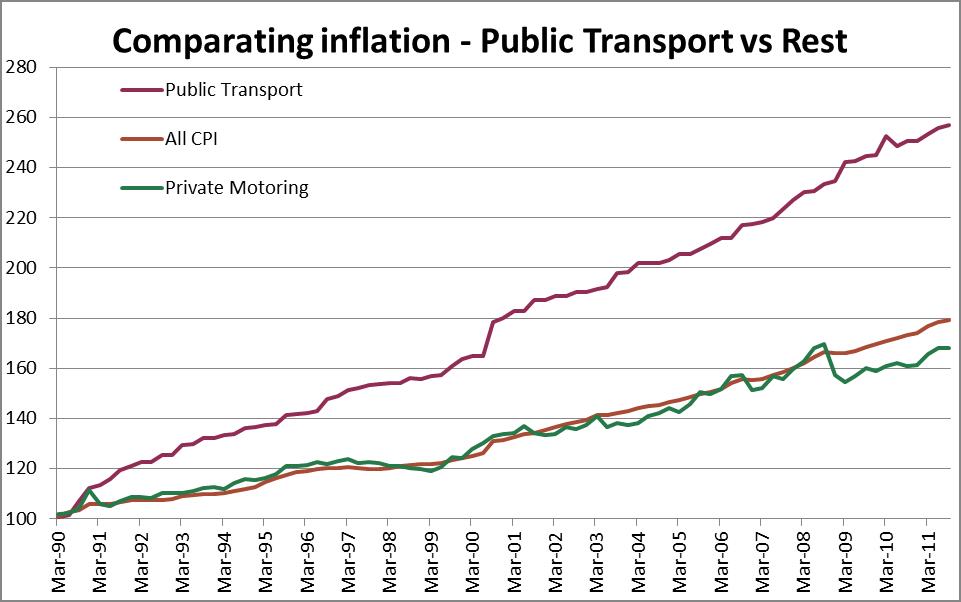
Throughout the 70s and 80s the increase in public transport prices mirrored that of the overall basket of goods. That is to say, the price of catching a train increased at similar rates to most other common goods. From 1990 onwards, however, the cost of buses, trams and trains has increased at a rate much higher than inflation (which includes housing costs, education, bananas, recreation and health, etc etc). While the cost of living in Melbourne increased 79% since 1990, by the time I sober up on New Year’s day, Melbourne’s public transport will have increased 190% in the same period.
Public transport’s elevated inflation is not only a Melbourne issue. Public transport has outgrown inflation by 97% across all of Australia’s capital cities. The graph below shows how Australian capital cities fare in terms of transport inflation compared to the overall Australian CPI.

(this google motion chart is not currently working… attempts will be made to reinstate it)

In the meantime… here is a temporary graph with similar data.

Public Transport Inflation

This phenomenon is made more remarkable when considering that the inflation for private motoring costs (including vehicle costs, fuel, parking, registration etc) has been lower than the total basket over the last few years. While the increase in cost of public transport is almost twice that of the overall basket, private motoring costs have increased 15% less than CPI since 1990.

I won’t speculate as to the reasons for this divergence.  Suffice to say that if we’re trying to encourage people to jump on the public transport bandwagon, a little economic incentive wouldn’t hurt.

__________

Dumplings stakeholder consultation

Dumplings stakeholder consultation

A few weeks back, in an impatient and self-absorbed move, I ordered dinner for myself and two colleagues as soon as we entered the dumpling bar of choice, without consultation.

Having drunk our way through the evening I was now too hungry to wait to eat, colleague #1 was too bladdery to wait to go to the toilet, and colleague #2 too out-of-focus to read the menu. Being a regular at the restaurant I knew the dishes well and so proceeded to chose a selection of pork and shrimp dumplings (steamed and pan fried for diversity), as well as some fantastic hand-made noodles with pork in a soy-based sauce. Having decisively shouldered the responsibilities as required, and taken care of the unpleasantries, I felt we could now move to more important matters (as soon as #1 returned from the loo that is). What I had not taken into account was that both of my dining companions were vegetarians.

Merde!

This lack of stakeholder consultation (the importance of which I should have learned through my various public servant roles) led to a good belly laugh at my expense and an interesting social situation when I offered to offload a fresh plate of dumplings to the neighbouring table of young HK girls (results: pan fried pork 0 – steamed prawn delicacies 6), but also my wondering whether vegetarianism in Australia had spread so far as to infect public servants. Surely NGOs had that market cornered.

Census fail

Unfortunately, I couldn’t find any conclusive evidence of the changing demography of the vegetarian community to satisfy my curiousity. In fact, I couldn’t even find much data on whether vegetarianism was spreading. However, the trend of meat consumption in Australia is of more interest to me. After all, for moral and environmental reasons, that the total amount of meat consumed is of more importance than the disparity of its consumption. In other words, I think it a better tactic that everyone decrease their meat consumption, even with a stable level of vegetarians, than increasing the number of vegetarians without decreasing consumption in the non-veggo community.

How has Australia’s meat consumption changed over the last decade or so?

My assumption was that due to the growing awareness of issues such as health (red meat and colons), moral (queue a variety of docos on animal rights and current animal mistreatment), and environmental (beef and dairy being one of the biggest contributors to domestic-consumption carbon emissions), consumption of meat in Australian households would have decreased slightly over the past decade. This was also backed up by my anecdotal evidence of being surrounded by vegetarians at dinner tables (even though I hang around a lot less bleeding hearts than I used to!).

Superbite me
From the late 1970s up until 1998 we had a great publication called Apparent Consumption of Selected Foodstuffs (by the ABS), but it’s no longer produced. So, to see the change over the past decade, I did some fairly rudimentary analysis. Based on Household Expenditure figures deflated by CPI (ie: inflation), I tried to work out the change in consumption of different food groups for Australians and found the following:Consumption of “meats” has increased by about 7% per capita. This includes all meats (beef, octopus, spam, kangaroo, barramundi, brains, chooks, bacon, lamb, etc etc etc) which were consumed at home..We also eat 7% more veggies, 11% more fruits and nuts and 15% more eggs! On the other hand we eat 6% less dairy products and 10% less carbs. Sounds to me like Atkins won!

“Meats” tell a story unto themselves.

Red meats (beef, veal, lamb and mutton) are taking a battering, decreasing by almost 20%, while fish and seafood increased by 19%.  The story of the day, however, is the original white meat. Chicken consumption per capita has increased by 60% in the last decade, and that doesn’t even include Nandos.

So, if there are more vegetarians amongst us, they are getting lost in the battery hens. But as far as environmental impact is concerned it appears we’re (very) slowly turning in the right direction. Even though we are consuming more of most things (bad), we seem to be consuming more of the less bad things (veggies, fruit, seafood and chicken), and less of the more bad things (red meats and dairy).

It seems to me that, ironically, the plummeting price of chicken, which probably occurred due to their terrible conditions, has had a much larger impact on our domestic emissions than any keep-cup/green-bag/car-pooling initiative out there.

_______________________________________________________
Big thanks to the ABS for their continuously supporting free access to information:
CPI: 
HES 1998-99: 
http://www.abs.gov.au/AUSSTATS/abs@.nsf/DetailsPage/6535.01998-99?OpenDocument
HES 2009-10: 

Streetlessness – a stationary concern

Streetlessness – a stationary concern

I think we’re selling ourselves short. Way short. Australia has some of the best food I have eaten. Sure, this comment can come across a little small-minded, even jingoistic, but I think there are many ways to justify this, which I hope to remember to go into on a post soon. However, regardless of the quality of our food, I don’t think we’re integrating it into our lives in a memorable and distinct manner. We have kept the act of eating at arms length from our lives.

A list of my most memorable meals, would have a splattering of family gatherings, weekend bbqs, a wedding or ten, and perhaps a few of life’s key moments, (queue the tears of joy, saddened longing stares and elated embraces). But once you normalise the equation of life, and focus on the food and atmosphere, then one thing stands out for me… the streets.

I recently got asked about my favourite meals ever, and of the top of my head the first few seemed to be consumed outdoors, standing up, walking or leaning against some railing dividing me from the adventure beyond it. I’m not, as it might be appearing, suggesting that I’m the outdoors type, but become one at feeding times.

I’m not entirely sure of the reasons behind this. Perhaps it’s the high results-to-expectation ratio, the russian roulette game being played with salmonela, or that any meat appears to be smoke-cured thanks to the passing traffic, but street (or market) food excite me like no other. I, like many, consume most of my meals at home, an eatery (includes restaurant/cafe/bar/etc), or glued to my work-desk. But whilst travelling, much like my modern cohort, I try to include a generous sprinkling of the outdoor variety.

Banana Crepes – Ho Chi Minh City
Unfortunately not only for tourists, but more so for locals, street food is a no-show across Australia!
Our travel guides are full of stories of where to get the best 20 baht pad thai, (Victory Monument – BKK has my vote), how to best match a pilsner to a bratwurst in Vienna, or how many tacos one can get for $2 in Guadalajara, but try picking up a bite on the run in Oz and you’ll probably end up scooping a pie at the 7eleven, or one of the trillion McChickenHuts conveniently located by your right foot.
All this despite a growing demand for these cuisines, with every second restaurant opening in Melbourne offering hawker style food, much like ‘tapas’ recently infested every restaurant and bar in the country like flu-carrying conquistadors. Street Thai, and now Street Vietnamese, are some of the biggest selling recipe books on the market, (and they’re not even a MasterCheff spin off!)
Unfortunately, when trying to bring the streets to Melbourne, they skip the pavement, jump a lane way, climb a staircase, and bring out the linen… a-la-carte anyone?
Chin Chin, one of the latest wonders of Melbourne’s culinary elite, has been described by Broadsheet (http://www.broadsheet.com.au/melbourne/food-and-drink/article/thai-diner-chin-chin-opens) as “street-inspired Asian food”. This much is surely true, but by the time you waited for a free table (20-50 minutes), viewed the menu (1-15), heard the omnipresent spill explaining how the menu is “designed to be shared” (waiter-dependant), ordered and received the plated food, the street cart which inspired this whole situation has crossed 12 red lights, smoked half a packet and sacrificed 7 chickens at the altar of palm oil!
Similarly overcooked is the menu. Unhappy for us to suffer through mediocrity, it’s quality produce throughout. The soups include blue swimmer crab wontons, Hopkins River beef, and Yamba King Prawns. And as wonderful as I assume they all are, (I’ve only tried 1), they were missing the key ingredient: asphalt.
If Chris Lucas were to stand on the corner of Collins and Russell Sts, serving his delightfully sticky caramelised pork with chilli vinegar, sans fanfare and half the price (seeing as the overheads would be nothing but blue skies), then I’d be heading to my nearest Flight Centre and getting myself a piece of that pie! Conversely, Australian cuisine will continue to be a technically proficient orchestra… there’s just no one dancing.